
Career Development and Employability Postgraduate Diploma (Distance Learning)
Start Dates
7 September 2026, 4 January 2027
Duration
1 year full-time, distance learning 2 years part-time, distance learning
Watch a Webinar
Register for our next live event or watch an on-demand webinar
Overview
Why choose Huddersfield for this course?
- You’ll have the opportunity to take the QCD - the nationally recognised professional qualification awarded by the CDI
- If you hold Level 6 Diploma in Career Guidance and employed in a professional career development role, you may be eligible to apply through APEL
- Study 100% online and benefit from our 40 years + sector expertise
Accreditation and Professional Links
Recognised connections to give you an extra edge when you graduate. Read More
This course is for current or aspiring career guidance and employability professionals across a range of settings such as schools, colleges, universities and government employment agencies, or those who work independently like career coaches or counsellors.
On this online course, you’ll learn about policy, practice and theories underpinning career guidance, equality and diversity, partnership working and research-based practice. You’ll have the opportunity to develop an understanding of critical reflection and how to employ independent learning strategies to enable you to evaluate and inform your professional practice, as well as developing and deepening your knowledge and understanding of educational research.
Why Career Development and Employability?
- The course can lead to a wide variety of interesting and rewarding career prospects in the career guidance and development sector including higher and further education careers and employability services, secondary education and third sector organisations. You can find out more via the CDI
- You’ll have the opportunity to take the Qualification in Career Development (QCD) - the nationally recognised professional qualification awarded by the Career Development Institute (CDI) - alongside the Postgraduate Diploma
- You’ll study 100% online on a one year full-time or two years part-time basis.
- Huddersfield has been teaching career guidance courses for over 40 years and has established a strong national reputation in the sector. You’ll also have access to our extensive professional and academic network which feeds directly into course design and delivery and to excellent facilities and specialist equipment.
- This course is open to graduates from any discipline, as well as applicants with a professional qualification and/or suitable experience.
Discover more about Distance Learning at Huddersfield.
Entry Requirements
Entry requirements for this course are normally:
- A degree or an equivalent professional qualification. Suitably experienced applicants without a degree will be considered.
In addition you must also have:
- Relevant experience in a paid or voluntary basis.
- Enhanced Disclosure and Barring Service (DBS) check.
Accreditation of Prior Experiential Learning (APEL)
If you hold the Level 6 Diploma in Career Guidance and Development and are currently employed in a professional career development role, you may be eligible to apply for entry to the MA or PgDip in Career Development and Employability through the Accreditation of Prior Experiential Learning (APEL) route.
Through this process, you may be able to claim up to 60 credits towards the programme, depending on the relevance and quality of your prior learning and experience. This route recognises both formal qualifications and professional experience.
Applicants will be required to submit an APEL portfolio, which outlines the evidence you have to support your claim.
All APEL claims are reviewed by academic staff in line with university policy.
To learn more about the APEL process, please visit our APEL guidance page. Accreditation of Prior Learning - University of Huddersfield
If your first language is not English, you will need to meet the minimum requirements of an English Language qualification. The minimum for IELTS is 6.0 with a minimum score of 6.0 in writing and a minimum of 5.5 in any single component or Duolingo English certificate, score 105 or above. Read more about the University’s entry requirements for students outside of the UK on our International Entry Requirements page.
Course Details
Whether you’re on the full-time or part-time course, you will study five core modules:
You will also have the option to choose one option module from a list which may include:
For more information on when and how we update our modules please see the ‘Legal Information’ section below.
Teaching and Assessment
Discover what to expect from your tutor contact time, assessment methods, and feedback process.
Technology and System Requirements
As a Distance Learning student, you must provide and have access to certain IT equipment and facilities to access your Virtual Learning Environment (VLE) and to fully participate on your course.
Placements
For learners undertaking the qualification on Career Development, you will be required to complete a minimum of 30 days of compulsory placement in an institution where career guidance is practised.
You will gain hands-on experience, allowing you to develop practical skills in delivering career guidance to both adults and young people.
Previous trainees have been placed in a range of settings including, the voluntary sector, higher and further education careers services, secondary education, workplaces and the National Careers Service.
Your Career
Guidance skills can be used in a diverse array of settings and graduates can expect to find employment in dedicated guidance or careers guidance agencies such as the National Careers Service, Higher and Further Education Careers Services, Voluntary and Charitable Agencies (e.g. mental health provision), Secondary Education, and Training Providers.
Previous graduates from courses in this subject area have gone on to work in a variety of roles such as Employment Consultant, Careers Advisor, Careers Coach, Careers Consultant, Head of Employment and Careers Advisor Team Leader.
Source: LinkedIn
98%
Percentage of our postgraduate students go on to work and/or further study within fifteen months of graduating.
* HESA Graduate Outcomes 2022/23, UK domiciled.
£38.5k
Average salary of our postgraduate students fifteen months after graduating.
* HESA Graduate Outcomes 2022/23, mean salary, UK domiciled, full-time UK employment as main activity.
The course gave me an excellent understanding of the Higher Education Careers landscape. It enabled me to feel confident and adept at structuring and carrying out competent career guidance. I feel the CDI Code of Ethics is ingrained in my practice as a result.Read More
- Emma Lees
Career Development and Employability PGDip Graduate
Fees and Finance
This information is for Home students applying to study at the University of Huddersfield in the academic year 2026/27.
Please note that tuition fees for subsequent years may rise in line with inflation (RPI-X) and/or Government policy.
For detailed information please visit https://www.hud.ac.uk/study/fees/
This information is for international students applying to study at the University of Huddersfield in the academic year 2025/26.
Please note that tuition fees for subsequent years may rise in line with inflation (RPI-X) and/or Government policy.
For detailed information please visit https://www.hud.ac.uk/international/fees-and-funding/
Career Development Institute (CDI)
In addition to the MA or PgDip you will also be working towards your professional qualification – The Qualification in Career Development (QCD).This is awarded by the CDI and is recognised nationally. There is an additional cost for this qualification which needs to be paid to the CDI directly.
A Disclosure and Barring Service (DBS) check is required to enable you to undertake placements in settings with children. We arrange this as part of the application process. Please note that there may be a charge for the DBS check.
Scholarships and Bursaries
Discover what additional help you may be eligible for to support your University studies.
Tuition Fee Loans
Find out more about tuition fee loans available to eligible postgraduate students.
What’s included in your fee?
We want you to understand exactly what your fees will cover and what additional costs you may need to budget for when you decide to become a student with us.
Funding options
Explore ways to fund your course with exclusive discounts and government loans
Read moreIf you have any questions about Fees and Finance, please email the Student Finance Team.
Explore More
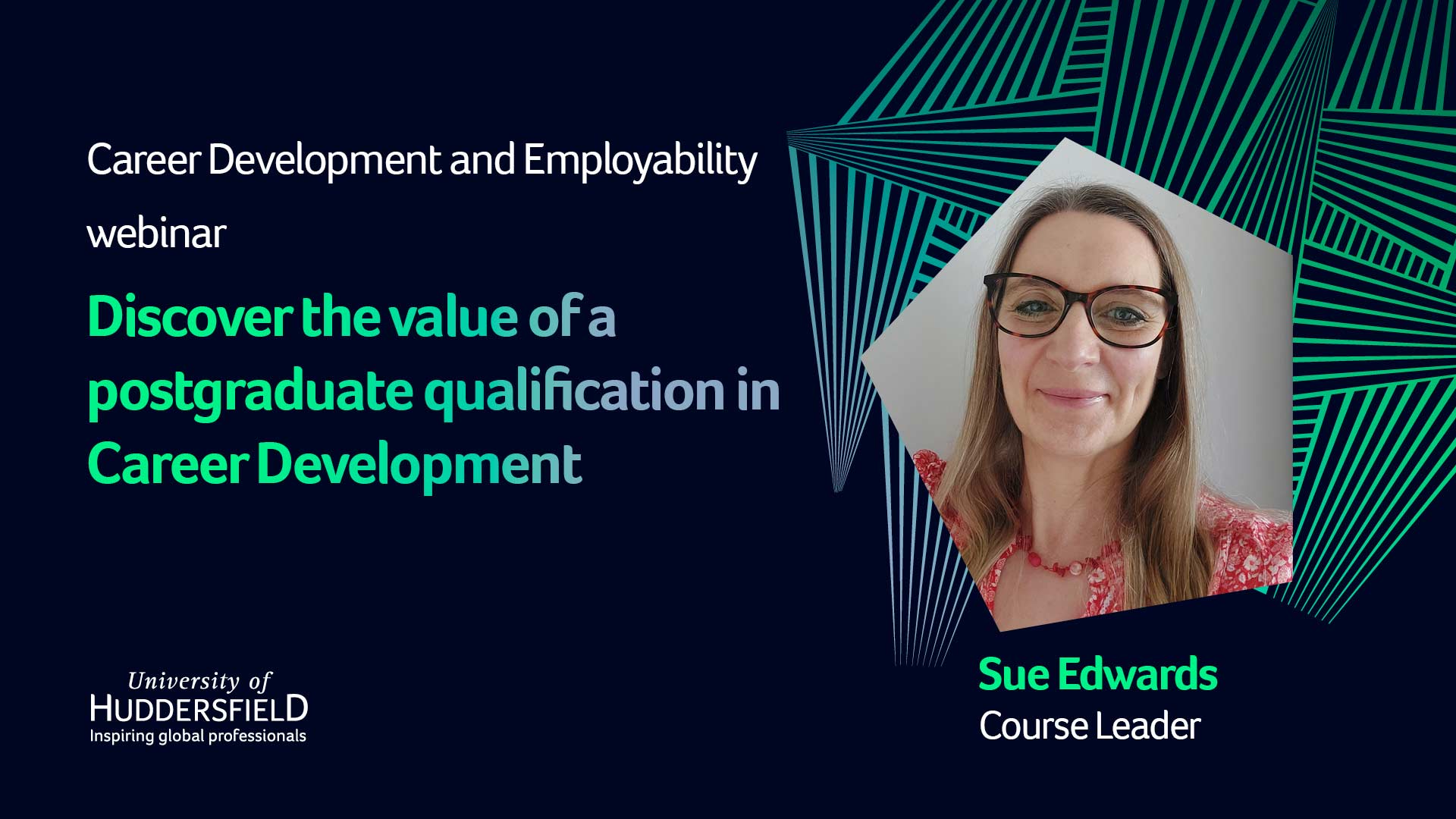
Watch our webinar
Discover the Value of a Postgraduate Qualification in Career Development: With insights from our Course Leader, Sue Edwards, plus our alumni and current students.

What our students say
"The course is challenging and academic, but it instantly changed how I went about my student interactions in my previous school. I was able to apply the theories and ideas from the course to real life very quickly, and I was able to see my students respond positively to these ideas. This has been really rewarding to see the personal and professional growth in such a short timeframe. "I have recently returned to the UK from Hong Kong and my experience on the course and the skills I have developed have not only helped me to secure two job interviews but also to receive two jobs offers, one of

Become a Careers Professional
Read our blog to discover how you can become a career development and employability professional.

Sue Edwards
Sue is a Senior Lecturer on the Career Development and Employability courses.
Why Hud
Explore the unique opportunities and resources that make our institution a top choice for students seeking a well-rounded and future-focused education.

Teaching Excellence
Our online courses are delivered by the same highly qualified academic staff who teach in-person at the University of Huddersfield. This means you’ll benefit from the same high standards in teaching excellence as our on-campus students.
Learn more
Affordable Study
Online study can be a cost effective way to obtain a prestigious qualification. There are no travel, accommodation or visa expenses and we don’t charge application or administrative fees. Plus, you can pay our competitive tuition fees in instalments, and spread the costs over time.
Learn more
Your Student Experience
Our online courses are designed to be interactive, engaging and inclusive. You’ll have the freedom to learn at your own pace, in your own time, while benefiting from live sessions and contact time with your Module Tutor, Personal Academic Tutor, Academic Skills Tutor and/or Project Supervisor.
Learn more
Graduate on campus
Our Distance Learning students are invited to our in-person graduation ceremonies so you can celebrate your success and meet your tutors and classmates. You’ll also have the opportunity to explore our beautiful campus.
Learn more
Reduced Inequalities
We’re ranked 1st in the world for Reduced Inequalities in the Times Higher Education Impact Rankings 2025, which celebrate commitment to the Sustainable Development Goals set by the United Nations.
Read moreMore Info
Careers support
We know you’re coming to university to study on your chosen subject, meet new people and broaden your horizons. However, we also help you to focus on life after you have graduated to ensure that your hard work pays off and you achieve your ambition.
Find out more about careers supportStudent support
At the University of Huddersfield, you will find support networks and services to help you get ahead in your studies. Our Distance Learning Unit Team are at hand to make your online learning journey a positive, rewarding and successful one.
Click for more infoTeaching Excellence
Great teaching is engaging and inspiring — it helps you reach your full potential and prepares you for the future. We don’t just teach well — we excel — and we have the awards and recognition to prove it.
Find out moreInspiring Academics
Our researchers carry out world-leading work that makes a real difference to people’s lives. Staff within the School of Education may teach you on this course.
Find out more about our staffResearch Excellence
You’ll be taught by staff who want to support your learning and share the latest knowledge and research.
Find out moreFurther Study
Many of our graduates stay at Huddersfield to complete postgraduate research degrees at Masters or PhD level.
Discover research degreesLegal information
When you enrol as a student of the University, your study and time with us will be governed by our terms and conditions, Handbook of Regulations and associated policies. It is important that you familiarise yourself with these as you will be asked to agree to them when you join us as a student. You will find a guide to the key terms here, along with the Student Protection Plan.
Although we always try and ensure we deliver our courses as described, sometimes we may have to make changes for the following reasons:
Changes to a course you have applied for but are not yet enrolled on
If we propose to make a major change to a course that you are holding an offer for, then we will tell you as soon as possible so that you can decide whether to withdraw your application prior to enrolment. We may occasionally have to withdraw a course you have applied for or combine your programme with another programme if we consider this reasonably necessary to ensure a good student experience, for example if there are not enough applicants. Where this is the case we will notify you as soon as reasonably possible and if you are unhappy with the change we will discuss with you other suitable courses we can transfer your application to. If you do not wish to transfer to another course with us, you may cancel your application and we will refund you any deposits or fees you have paid to us.
Changes to your course after you enrol as a student
Changes to option modules
Where your course allows you to choose modules from a range of options, we will review these each year and change them to reflect the expertise of our staff, current trends in research and as a result of student feedback or demand for certain modules. We will always ensure that you have an equivalent range of options to that advertised for the course. We will let you know in good time the options available for you to choose for the following year.
Major changes
We will only make major changes to non-optional modules on a course if it is necessary for us to do so and provided such changes are reasonable. A major change is a change that substantially changes the outcomes, or a significant part of your course, such as the nature of the award or a substantial change to module content, teaching days (part time provision), type of delivery or assessment of the core curriculum. For example, it may be necessary to make a major change to reflect changes in the law or the requirements of the University’s regulators or a commissioning or accrediting body. We may also make changes to improve the course in response to student, examiners’ or other course evaluators’ feedback or to ensure you are being taught current best practice. Major changes may also be necessary because of circumstances outside our reasonable control, such as a key member of staff being unable to teach due to illness, where they have a particular specialism that can’t be adequately covered by other members of staff; or due to pandemics, other disasters (such as fire, flood or war) or changes made by the government.
Major changes would usually be made with effect from the next academic year, but may happen sooner in an emergency. We will notify you as soon as possible should we need to make a major change and will consult with affected groups of students and any changes would only be made in accordance with our regulations. If you reasonably believe that the proposed change will cause you detriment or hardship we will, if appropriate, work with you to try to reduce the adverse effect on you or find an appropriate solution. Where an appropriate solution cannot be found and you let us know before the change takes effect you can cancel your registration and withdraw from the University without liability to the University for any additional tuition fees. We will provide reasonable support to assist you with transferring to another university if you wish to do so and you may be eligible for an exit award depending on how far through your course you are.
In exceptional circumstances, we may, for reasons outside of our control, be forced to discontinue or suspend your course. Where this is the case, a formal exit strategy will be followed in accordance with the student protection plan.
The Office for Students (OfS) is the principal regulator for the University.